Utter Loyalty is the industry’s podcast that gets beyond the polished programme launches, points mechanics and industry jargon to talk about what loyalty actually looks like inside a business.
At TBH Loyalty™ London 2026, host Emma Collins from Hobby Craft sat down with Louisa Evans, Head of Customer Loyalty and Retention from Hornby Hobbies to talk about a loyalty programme that is now three years old — and what Hornby has learnt from actually watching its customers behave.
The audio gods unfortunately had other ideas, so this conversation never made it to the podcast feed. But it was too good to lose.
Because Louisa’s message isn’t really about rewards. It’s about knowing when customers need them — and when they don’t. That’s smart loyalty.
When your customers already love you, what is loyalty supposed to do?
Hornby Hobbies has an enviable starting point.
Its brands include Hornby, Scalextric, Airfix and Corgi. These aren’t simply products people buy. They are hobbies people spend hours, sometimes decades, immersed in. Collections are passed between generations. Grandparents build with grandchildren. Enthusiasts don’t need much encouragement to tell you exactly what they think.
During the interview, Louisa jokes that she may have “the world’s easiest loyalty job” because of that existing passion.
But it creates another problem.
If somebody was going to buy from you anyway, what exactly are you rewarding?
As Emma asked during their conversation: how do you know whether a loyalty programme is genuinely changing behaviour rather than simply incentivising a purchase that would have happened anyway?
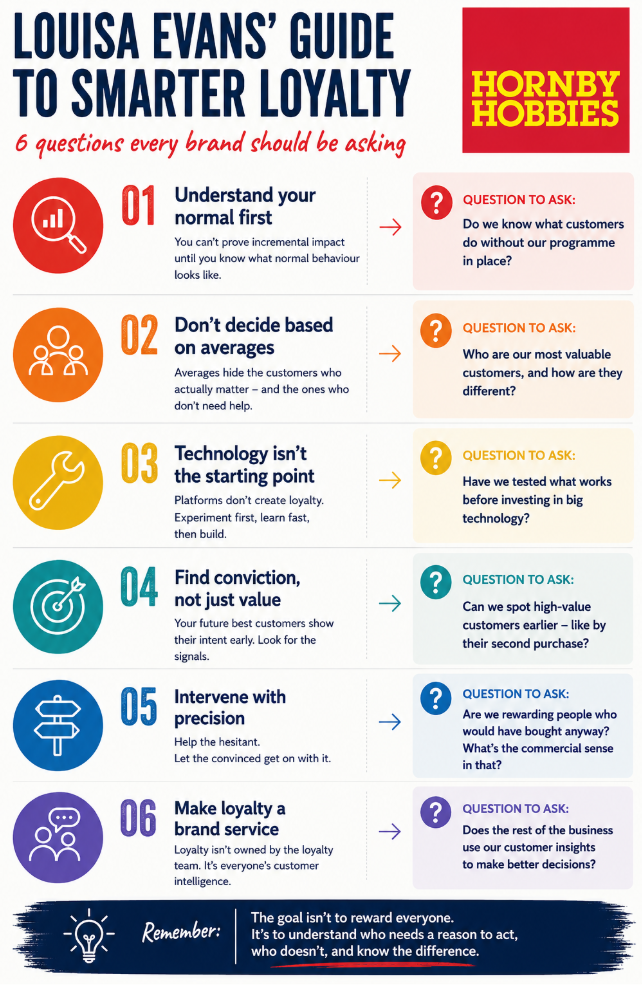
Louisa’s answer starts somewhere surprisingly basic: understand what normal looks like first.
When she arrived at Hornby, the programme was still young. Rather than rushing to declare an incremental uplift or ROI, the team needed time to understand existing purchasing patterns.
For some Hornby customers, another purchase might not happen for a year or two. Louisa found herself looking across five years of data to understand those behaviours properly.
“You’ve got to start tracking your normals first.”
It’s difficult to claim you’ve changed customer behaviour if you haven’t established what that behaviour looked like without your intervention.
Stop making decisions based on the average customer
One of Louisa’s first exercises was an RFM analysis — looking at recency, frequency and monetary value.
And it quickly exposed another problem with the way businesses talk about customers.
Average order value. Average lifetime value. Average frequency.
Useful numbers. Until they aren’t.
“Don’t make decisions on average. Not everyone’s the same.”
Different Hornby customers behave in fundamentally different ways. Understanding those populations — rather than squashing everybody into one convenient average — gives the business a far better chance of deciding where intervention will actually make a difference.
That thinking became the basis of Louisa’s presentation at TBH Loyalty London: Stop Rewarding Everyone: Finding the Vital Few at Hornby Hobbies.
The uncomfortable question behind it is simple:
What if treating everybody equally isn’t fair loyalty — it’s just bad economics?
Technology doesn’t magically make loyalty happen
Hornby went through rapid technological change as the business shifted from being overwhelmingly B2B towards developing a much stronger direct relationship with its customers.
Louisa is a big advocate of the technology available to loyalty teams. But she is equally clear about its limitations.
“The implementation of the platform doesn’t magically make the loyalty happen.”
Her advice to businesses considering a programme is to resist starting with the shiny platform.
Run experiments first.
Small ones. Low-tech, low-code tests that tell you how customers respond, what data you actually have, what passes between systems and where things fall over.
Then build.
Otherwise, rapid implementation can leave businesses with something Louisa describes rather neatly as both tech debt and skill-set debt — systems that need fixing and teams scrambling to learn how to use them.
Loyalty isn’t owned by the loyalty team
Perhaps the strongest point comes towards the end of Emma and Louisa’s conversation.
“Loyalty isn’t owned by the loyalty manager or the loyalty team.”
For Louisa, the real breakthrough isn’t another dashboard or campaign result.
It’s when someone from elsewhere in the business — a brand owner, product colleague or another stakeholder — looks at the customer data and says: Yes. That makes sense. That’s what I’ve been seeing too.
That’s her “ta-da” moment.
Because at that point, customer data stops being something the loyalty team reports and becomes something the wider business can actually use.
Louisa describes loyalty as “a brand service” — another way for a brand to have a conversation with its customers.
And perhaps that’s the bigger lesson from Hornby.
The objective isn’t to make everyone behave the same way.
It’s to understand who is already convinced, who is hesitating, who is worth investing in — and when doing absolutely nothing might be the smarter commercial decision.
Want more conversations like this? Come and join us in Amsterdam.
Louisa’s conversation is exactly why we created Utter Loyalty. No rehearsed case studies. No pretending everything worked perfectly. Just people doing the job, talking openly about what they’re learning, questioning and changing.
And we’re taking it back onto the event floor at TBH Loyalty™ Amsterdam on 6th-7th October, where Emma will be sitting down with loyalty practitioners from across Europe, including dm-drogerie markt, Just Eat Takeaway.com, IKEA, Strawberry, the LEGO Group and Foot Locker.
If you want to hear how the people actually running loyalty are thinking about it — including the bits that don’t normally make the conference slides — come and be part of it.
Register for your complimentary ticket at TBH Loyalty Amsterdam here and join us for the conversations.