
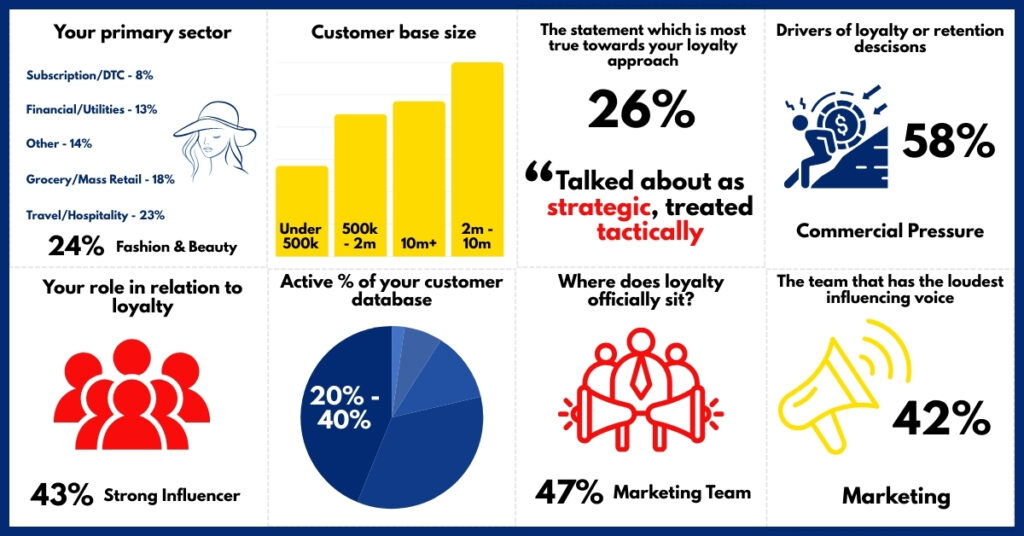
At TBH Loyalty™ London, we asked 120 brand practitioners one simple thing: tell us how loyalty and retention actually work inside your organisation.
They answered 26 questions covering ownership, decision drivers, data confidence, operational pace, technology constraints and AI ambition. The result is a clear, collective snapshot of where loyalty stands right now across sectors and markets.
Why does that matter to you?
Because loyalty leaders often feel like they’re fighting battles in isolation — defending budgets, proving commercial impact, pushing for better data, navigating cross-functional friction. This research shows you’re not alone. Many of the same tensions show up again and again, regardless of sector or scale.
It also provides something practical: perspective. The findings offer a useful benchmark you can take back to your own senior leadership teams. If you’re arguing for greater investment, more flexibility, stronger integration or clearer ownership, this data helps ground those conversations in industry reality rather than opinion.
This isn’t about ranking brands or declaring maturity levels. It’s about capturing how loyalty and retention are genuinely being run — the strengths, the friction and the ambition.
Below is what the room told us.
Download the infographic here to explore the full findings and see how your experience compares to brands across sectors and markets.
1. Loyalty Is Established — and Commercially Accountable
This is not an industry experimenting at the edges.
76% run a formal loyalty programme, with a further 12% running structured CRM or retention without a formal programme
Engagement is complex by default.
60% are omni-channel (store and digital), with 27% operating e-commerce only
When it comes to decision-making, the commercial lens dominates.
58% say commercial pressure drives loyalty decisions, compared to 22% who say customer insight is the primary driver
And when loyalty is challenged internally?
57% rely on hard commercial evidence to defend it
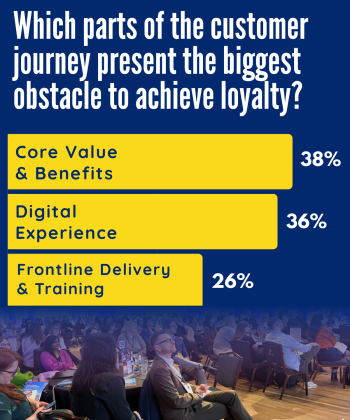
2. Data Is There — Confidence Is Measured
Confidence in data is steady, but not overwhelming.
46% describe themselves as mostly confident, while 33% say their data is mixed or inconsistent. Only 13% say they are very confident
Transactional behaviour remains dominant.
60% say transactional data shapes loyalty decisions, far ahead of CRM profiles, research or digital signals
Data exists. Few feel it is bulletproof.
3. Operational Friction Is Real
Change isn’t instant.
43% say meaningful changes require a business case and patience, and around 49% say changes involve several teams
Technology is rarely described as seamless.
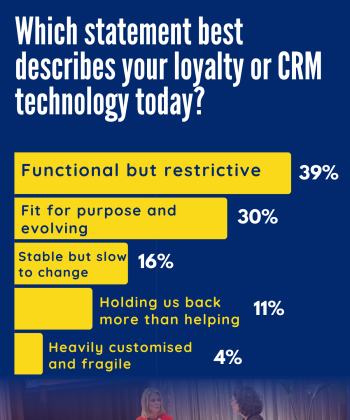
39% call their CRM or loyalty tech functional but restrictive, with others describing it as stable but slow
Test-and-learn is present — but not embedded everywhere.
52% say experimentation happens occasionally, while only 21% say it is built into how they work
There’s movement. There’s ambition. But friction is normal.
4. Ambition Is High — AI Is Emerging
Looking ahead, AI is clearly on the radar.
48% see the biggest opportunity in personalisation at scale, yet only 12% say AI is actively in use today
Most brands are building capability — not claiming leadership.
Perhaps the most reassuring insight: the majority describe themselves as meeting the business case while continuing to build belief internally, rather than positioning themselves as industry-leading
The Takeaway
Loyalty is commercially embedded, structurally complex and still evolving. Most brands are navigating similar pressures — proving value, managing cross-team friction and working towards deeper integration.
If any of that sounds familiar, you’re not behind. You’re in the same boat!.
Download the infographic to explore the full findings and see how your experience compares to brands across sectors and markets.
