
84% Admit They’re Still Not Doing The Real Thing
Personalisation has become one of the most talked-about topics in loyalty, CRM and customer engagement.
It’s featured in strategy decks, conference presentations and technology roadmaps for years.
But how close are organisations to actually delivering it?
That was the question explored during the latest ELA™ Loyalty Brunch, where loyalty and CRM leaders from across Europe came together for an honest discussion on the reality of personalisation today. Joined by Donna Orman, Director of Personalisation at Tesco, the conversation revealed a striking gap between ambition and execution.
The pre-event survey painted a clear picture.
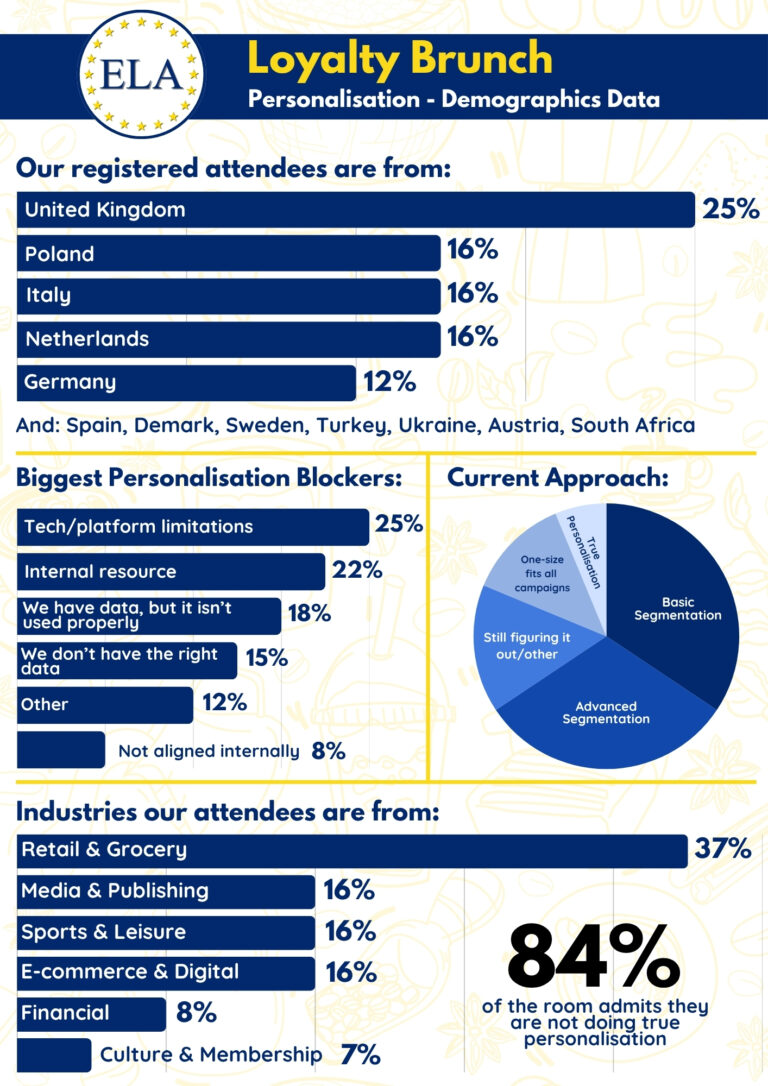
Whilst personalisation remains a priority, only a small minority of attendees described their current approach as true one-to-one personalisation. Most admitted they were still relying on basic or advanced segmentation, and 84% acknowledged they were not yet delivering genuine personalisation at scale.
In other words, despite years of investment, most organisations still feel they are on the journey.
Start With The Customer
Donna opened the discussion with a reminder that personalisation should never start with technology.
It should start with the customer.
“Always start with the customer.”
For Donna, the objective of personalisation isn’t simply to send more targeted messages or create more segments. It’s about understanding what value you’re trying to create for customers and being clear about the business outcome you’re trying to achieve.
Whether that is driving loyalty, increasing engagement, encouraging growth or creating new commercial opportunities, organisations need a clear purpose before they start building capabilities.
Without that focus, personalisation risks becoming an expensive exercise that creates activity without impact.
The Ferrari Problem
One of the strongest themes of the discussion was that technology is rarely the biggest challenge.
Most organisations already have access to more customer data, platforms and tools than ever before.
The real challenge lies elsewhere.

As Donna explained:
“I’ve got a Ferrari in the garage, but I’ve still got a 30-mile-an-hour speed limit.”
Her point resonated with many attendees.
Businesses are investing in powerful technology, but organisational processes often haven’t evolved at the same pace. Sign-off procedures, governance structures, internal alignment and competing priorities can all slow progress dramatically.
The result is that organisations often have the capability to move faster than they actually do.
As Donna put it:
“You can get all the technology in the world, but if you aren’t changing how the business is thinking, none of it comes together.”
The conversation highlighted that successful personalisation is as much a cultural challenge as a technical one.
Data Still Sits At The Centre
Unsurprisingly, customer data emerged as one of the biggest challenges facing attendees.
Several participants spoke openly about fragmented customer journeys, disconnected systems and incomplete views of customer behaviour.
Veruschka Haas, from Flying Tiger Copenhagen shared the challenge of understanding customer behaviour across both retail and ecommerce environments:
“We have no idea what they’re shopping for when they are in retail.”
For many organisations, customers move between channels without leaving a consistent trail of data. This makes it difficult to build a complete picture of behaviour and even harder to deliver relevant experiences at the right moment.
The discussion also highlighted the importance of customer identification, loyalty programme participation and data strategy. Collecting data alone is not enough. Organisations need a clear plan for how that data will be used both today and in the future.
Beyond Segmentation
A recurring question throughout the session was simple:
Where does segmentation end and personalisation begin?
Many attendees admitted they were still operating largely through audience segments rather than individual customer decisioning.
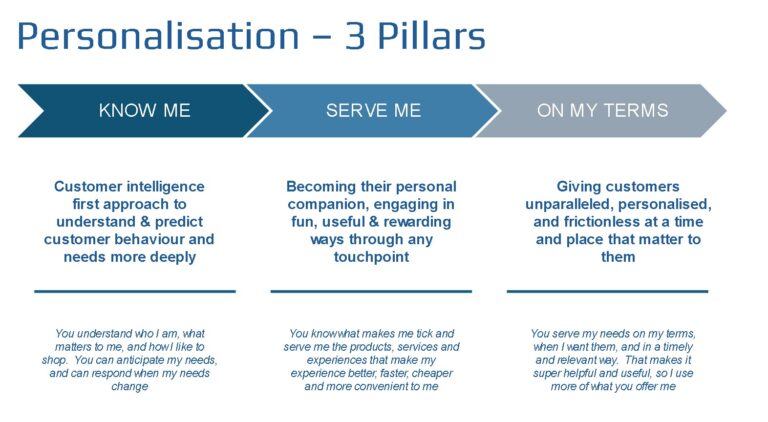
Donna introduced a framework she uses to think about personalisation:
Know Me
Understanding customer needs, behaviours and preferences.
Serve Me
Delivering relevant products, services and experiences.
On My Terms
Providing value at the right moment, through the right channel, in the way the customer wants it.
The discussion suggested that many organisations are making progress on the first two.
The third remains the hardest.
The challenge isn’t simply knowing customers better.
It’s responding quickly enough, intelligently enough and consistently enough to make that knowledge meaningful.
Looking Ahead
When asked what personalisation might look like in five years’ time, Donna predicted a future that is far more conversational, predictive and responsive.
Customers will expect brands to anticipate needs, understand changing circumstances and respond in real time. AI, decisioning platforms and orchestration technologies will undoubtedly play a major role.
However, the discussion concluded that technology alone won’t get organisations there.
The brands that succeed will be those that combine customer understanding, organisational alignment, experimentation and a clear strategy for how data creates value.
Perhaps the most revealing moment came towards the end of the session.
When asked whether they already had a mature personalisation strategy in place, very few participants felt confident enough to say yes.
For an industry that talks about personalisation constantly, that honesty may have been the most valuable insight of all.
Because the reality is that most organisations are still figuring it out
Want to hear the full discussion?
ELA™ members can access the complete recording including practical use cases, tool recommendations and peer-to-peer insights from loyalty and CRM leaders across Europe.
Email hello@the-ela.org to for the recording link.
*We promote Chatham House rules, so please do not share the recording with anyone outside of the ELA membership.
