
Is 180 cm tall? Easy question, until you try to answer it. In some countries, yes. On a basketball court, probably not. At 170 cm, most people would say no. At 195 cm, most people would say yes. But somewhere in the middle, the line becomes strangely uncomfortable. There is no magical centimeter where a person suddenly becomes tall.
Now bring this small problem into CRM. What does it mean that a customer has churned?
What can fuzzy logic teach CRM teams about customer behaviour?
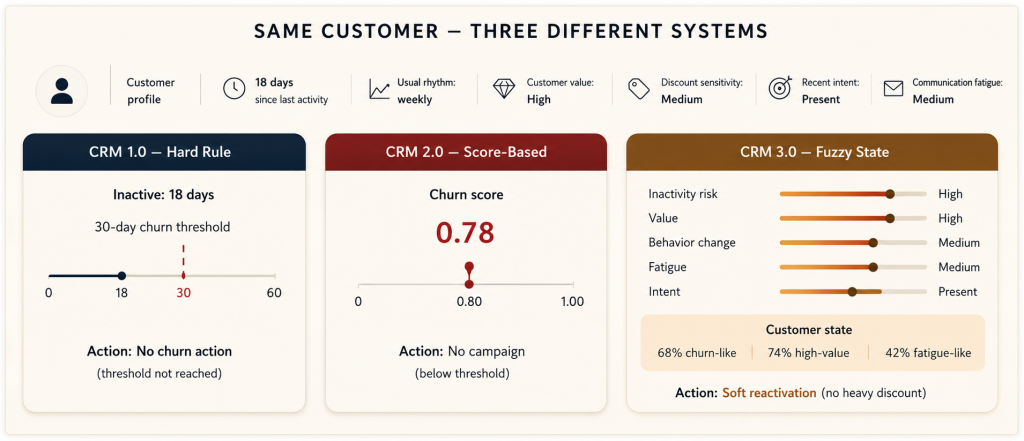
CRM 1.0: The Line
In CRM, we often look at 7-day, 30-day or 90-day activity windows. This makes sense. These metrics give structure, help us follow the customer base over time, and make reporting easier. They are useful for dashboards, trend analysis and management updates. If we want to understand whether the active base is growing or shrinking, a fixed activity window is a perfectly reasonable starting point.
The problem begins when this reporting logic becomes the actual CRM trigger. If 30-day inactivity is our definition of churn, when should we act? On day 29? On day 25 with a five-day campaign? On day 6, just to protect the 7-day activity KPI? And why would we use the same trigger for a customer who usually interacts every day, another who comes back weekly, and another who has always had a monthly rhythm? The issue is not the metric itself. The issue is pretending that the same inactivity window means the same thing for every customer.
CRM 2.0: The Score
CRM teams saw this problem, so we moved to scores. Instead of asking whether someone crossed a fixed inactivity line, we started comparing customers to their own behaviour. Has their rhythm changed? Is the drop unusual? Are they seasonal? Are they browsing, buying less, or simply acting differently?
This is a big improvement. Churn scores, engagement scores and propensity scores are much smarter than fixed rules. Then we often do something strange: we take the score and draw another hard line through it. If churn score is above 0.80, send campaign. The customer at 0.79 gets nothing. The customer at 0.80 enters the journey. Did something magical happen between 0.79 and 0.80? Probably not.
What Does Science Say?
This is where fuzzy logic is useful. The idea goes back to Lotfi A. Zadeh’s 1965 paper Fuzzy Sets. The point is simple: many real-world categories have soft edges. A person does not suddenly become tall at exactly 180 cm. A watch does not become expensive at one universal price. A customer does not become loyal after exactly five purchases, and does not suddenly churn on day 30.
Fuzzy logic describes these states by degree. In CRM language, the better question is not “has this customer churned?”, but “to what degree does this customer behave like a churn-risk customer?” Behind the scenes, fuzzy logic has all the proper mathematical furniture: set theory, membership functions, fuzzy relations, if–then rules, aggregation, defuzzification. Excellent words for frightening a meeting room. Fortunately, we do not need the math today. The practical lesson is enough: many CRM concepts are degrees.
CRM 3.0: The Customer State
Churn is only the first example. Customer value is fuzzy. Loyalty is fuzzy. Discount dependency is fuzzy. Communication fatigue is fuzzy. Reactivation readiness is fuzzy.
A customer can be high value, mildly churn-risky, seasonal, low-fatigue and still browsing a relevant category. Another customer can have the same churn score, but be over-contacted, discount-trained and showing no real intent. Same score. Very different decision.
CRM 3.0 is the shift from isolated scores to customer states. The best trigger is not a line. It is a balance point between risk, value, timing, customer rhythm, channel pressure and expected response. Fuzzy logic gives CRM teams a scientific reason to stop worshipping single scores and start seeing the customer as a bigger picture. The uplift is already proven; this is exactly the kind of CRM problem where it pays to let science in.

Mátyás Marodi
CRM consultant and customer behaviour researcher at Corvinus University of Budapest, working across iGaming, e-commerce and cultural industries. He leads CRM for an award-winning Asian sportsbook and casino, manages projects across four continents, and divides his time between Budapest and Manila
