
When people talk about loyalty programmes, the conversation usually centres on customer retention, personalisation, lifetime value and commercial growth.
All important topics.
But every so often, a piece of work comes along that reminds us loyalty can have an impact far beyond the checkout.
At Europe’s Loyalty Association (The ELA™), we’re proud to be supporting the Cancer Loyalty Card Study (CLOCS), a pioneering research programme led by Professor James Flanagan at Imperial College London and funded by Cancer Research UK.

It poses a remarkably simple question:
Could the shopping habits recorded through loyalty programmes help identify the early signs of cancer?
Looking for clues in everyday shopping
Many cancers develop gradually and begin with symptoms that are vague and easily dismissed.
Persistent bloating. Indigestion. Stomach pain. Fatigue.
They’re symptoms many people try to manage themselves before ever considering a visit to their GP.
The CLOCS researchers wondered whether those early symptoms might already be leaving a trail—not in medical records, but in supermarket baskets.
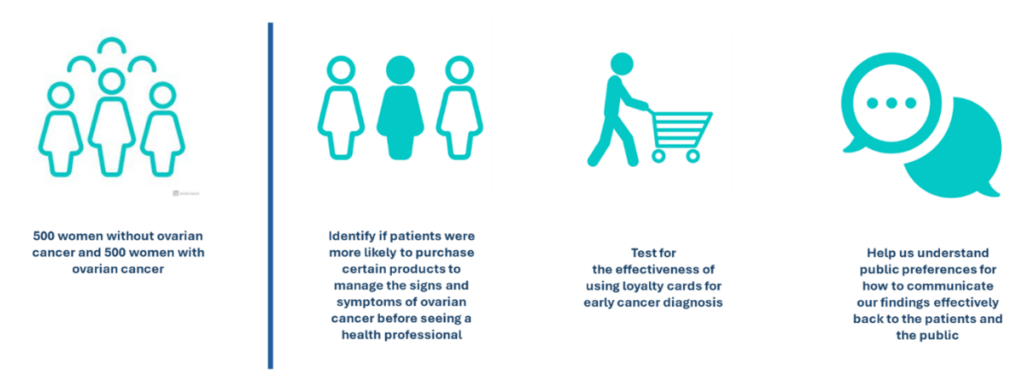
Would people unknowingly begin buying more pain relief, indigestion remedies or other over-the-counter products months before receiving a diagnosis?
Using consented loyalty card data from participants shopping at Tesco and Boots, the research team set out to find out.
What they discovered
The findings from the first Cancer Loyalty Card Study CLOCS-1 were striking.
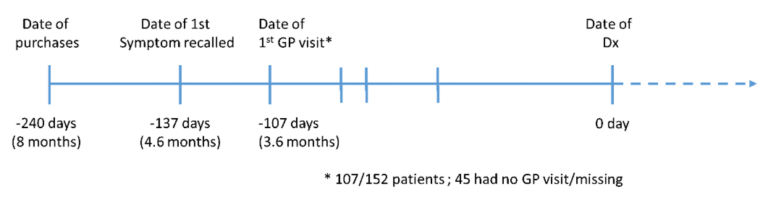
Researchers found that women who were later diagnosed with ovarian cancer had increased purchases of pain relief and indigestion medication up to eight months before diagnosis. In some cases, changes in purchasing behaviour appeared even before participants recalled recognising symptoms themselves or visiting their GP.
It was the first study of its kind to demonstrate that everyday retail transaction data could provide meaningful insights into disease detection.
The work has since been published in the peer-reviewed journal JMIR Public Health and Surveillance, adding scientific credibility to what many initially considered an unconventional idea.
The next chapter
The research hasn’t stopped there.
The current phase, CLOCS-2 (2024–2027), has expanded beyond ovarian cancer to investigate ten different cancer types, including pancreatic, bowel, oesophageal, liver, bladder and stomach cancers. The team aims to recruit up to 3,000 participants, analysing purchasing behaviour to uncover patterns that could support earlier diagnosis across a much broader range of cancers.
Looking further ahead, the ambition becomes even greater. Future research aims to partner with more retailers and their loyalty programmes, researchers hoping to create one of the world’s most significant Digital Health studies, exploring how everyday shopping behaviour could transform early cancer detection and support future health research. Funding for this next phase is currently being sought.
Data used responsibly
Whenever customer data is discussed, questions around privacy rightly follow.
CLOCS has been built with consent and governance at its core.
Participants actively choose to take part and authorise researchers to access their loyalty card purchase history. Data is transferred securely, protected under GDPR, managed through formal data-sharing agreements with participating retailers and analysed within Imperial College London’s ISO27001-certified secure research environment.
This isn’t about commercial profiling.
It’s about using data responsibly to advance public health.
Why this matters to our industry
For years, loyalty professionals have described first-party data as one of their greatest assets.
CLOCS challenges us to think differently about what that asset could achieve.
Rather than asking only how loyalty data can improve personalisation or increase spend, this research asks a far more profound question:
Can loyalty data improve lives?
The project has already attracted national media attention, won the 2023 DataIQ Award for Best Non-Commercial Use of Data, and demonstrated what becomes possible when retailers, researchers and healthcare organisations collaborate around a shared purpose.
It’s a reminder that the loyalty industry has an opportunity to contribute to society in ways many of us have never previously considered.
Why The ELA™ is supporting CLOCS
One of our roles at Europe’s Loyalty Association (The ELA™) is to champion initiatives that demonstrate the wider value of loyalty.
Projects like CLOCS show that loyalty programmes are more than marketing channels. They can become powerful platforms for research, innovation and positive societal impact when used ethically and responsibly.
We believe this is exactly the kind of work our industry should know about.
Could your organisation help?
As the research expands, the CLOCS team is keen to engage with additional retailers and loyalty programmes.
If your organisation operates a loyalty programme and would like to explore how it could contribute to this groundbreaking research, we’d encourage you to start a conversation.
Whether you’re simply curious or interested in supporting the next phase of the study, we’d be delighted to introduce you to Professor James Flanagan and his team at Imperial College London.
Sometimes the most important thing a loyalty programme delivers isn’t another purchase.
It might just be the opportunity to help save lives.
To learn more about the Cancer Loyalty Card Study (CLOCS), or to discuss how your organisation could support the research, please contact ELA CEO, Hadie Perkas who will be pleased to introduce you to Professor James Flanagan at Imperial College London.
