
What happened when Europe’s loyalty community came together in Amsterdam to challenge assumptions, share the numbers and ask whether we’re actually changing customer behaviour?
On 6–7 October 2026, 329 loyalty, CRM and customer engagement professionals gathered in Amsterdam for the biggest edition yet of The BIG Handshake Loyalty™ (TBH), organised by Europe’s Loyalty Association (The ELA™).
Two days. Two content tracks. Some of Europe’s best-known brands. A room full of opinions. And plenty of questions that didn’t come with comfortable answers.
From commercial performance and technology decisions to neuroscience, AI and human behaviour, the agenda explored a fundamental challenge: are brands building genuine customer relationships, or simply getting better at rewarding behaviour that would have happened anyway?
The industry arrived with some familiar headaches
Before the event, delegates told us what was keeping them awake at night.
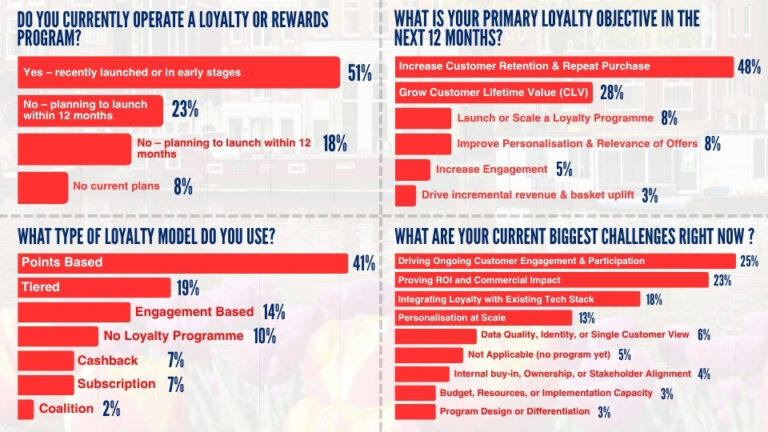
Almost half (48%) identified retention and repeat purchase as their biggest objective for the next 12 months. A quarter cited ongoing engagement as their biggest challenge, while 23% pointed to proving ROI and commercial impact.
These weren’t abstract concerns. They shaped two days of presentations, practical case studies and occasionally uncomfortable discussions.
Day One tackled costs, revenues and commercial realities. Day Two turned towards human behaviour: why people make decisions, form habits, respond to rewards and sometimes walk away.
Are we measuring loyalty or congratulating ourselves?
The question of commercial value ran throughout the event.
Shama Wilson from Tesco shared the challenge of modernising Clubcard while protecting its strengths, aligning teams and building organisational belief.
Tijn van der Heijden from bol offered a different perspective on customer loyalty in e-commerce. Customers compare, click and switch within seconds. Emotional devotion isn’t necessarily the goal. Becoming their default choice through convenience, habit and reduced friction might be far more valuable.
His warning was particularly memorable: a programme designed to motivate customers can inadvertently make them feel they’ve lost something when their progress resets.
Meanwhile, Zsuzsa Kecsmar from Antavo revealed preliminary findings from its forthcoming Global Customer Loyalty Report 2027.
79% of marketers believe their loyalty programmes make customers feel valued. Only 60% of consumers agree.
And seven in ten consumers reported having stopped using at least one loyalty programme.
That’s quite a gap between what brands believe they’re delivering and what customers actually experience.
But there was encouraging evidence too. Scandic Hotels, presenting alongside Antavo, demonstrated how redesigning its membership proposition around changing customer expectations contributed to a 23% increase in spend per active member and 14% growth in active members.
The lesson? Don’t protect a programme simply because it exists. Protect its relevance.
“The talks were the best this year. All the content was incredibly engaging“
Bruna Mikan — ASICS
Engagement needs to earn its place
With 41% of registration respondents reporting points-based loyalty models, the question of what actually drives engagement felt particularly relevant.
Nectar and adjoe demonstrated how mobile gaming can give members reasons to interact between purchases. Their partnership reported 27% more app activity, with 33% of Arcade users new to the wider Nectar coalition.
Crucially, the gaming studios fund the rewards, creating a potential revenue stream rather than another cost centre.
Co-op and Playable explored how gamification can create more participative membership experiences, while Bruna Mikan from ASICS challenged the industry to think beyond transactions and reward behaviours connected to a brand’s purpose.
And at LEGO, Aaron Mitchell and Myrthe van Dieijen shared what happens when membership stops being treated as another CRM channel and becomes part of how the wider business thinks about its customers.
Different businesses. Different approaches. One recurring question: are we giving customers more reasons to care, or simply more things to do?
Understanding the brain behind the behaviour
One of the event’s biggest additions was two extended, interactive workshops led by Chartered Psychologist and Neuroscientist Dr Simon Moore and Brand Strategist David Jenkinson, exploring the psychology and neuroscience behind customer decisions, habits and emotional connections.
Their sessions challenged delegates to look beyond loyalty mechanics and ask a more fundamental question: what actually happens in the brain when people choose, trust and return?
The workshops also marked the official launch of The ELA’s Diploma in Loyalty Neuroscience (DLN), a new professional learning programme designed to help practitioners apply behavioural science to real commercial challenges.
The first live programmes will take place in London on 24–25 February 2027 and Amsterdam on 12–13 May 2027.
“I really liked the neuroscience sessions, and seeing how other brands have similar challenges and how they overcame them.”
Julie De Stordeur — TUI
More technology. More data. But do we understand customers any better?
AI was impossible to ignore, but the conversations went considerably further than automation and efficiency.
Maria Moreau from Boozt confronted the professional and personal uncertainty facing CRM leaders as AI reshapes their roles. Eva Molsich from Douglas brought the question to life through an unconventional conversation with an AI companion.
Jip Koudijs from IKEA reminded delegates that great customer experiences depend on engineering decisions, collaboration and foundations that customers rarely see.
Our lead sponsor, Braze, brought a strong commercial perspective through Karan Gupta from Too Good To Go, exploring how CRM can become a growth engine rather than a collection of campaigns.
Speaking with The ELA’s Hadie Perkas during the event, Braze’s Britta Stumvoll captured one of the industry’s biggest contradictions:
“Companies are having more data and more tech than ever before, but customers still don’t feel understood.”
Britta discussed how AI could move personalisation beyond inserting someone’s name into an email towards reaching individuals through the most relevant channels and messages.
Her advice to leaders returning to work with dozens of new ideas was refreshingly practical: don’t try to do everything. Start somewhere, learn and build.
The conversations didn’t stop when the presentations finished
Of course, TBH Loyalty™ has never been designed as an event where everyone sits quietly listening for two days.
Our table activity, “Pick A Side” challenged delegates to take positions on difficult commercial and strategic questions. These discussion cards encouraged people to defend their thinking, listen to opposing views and reconsider their assumptions.
Conversation Hubs, networking tables and informal exchanges brought people together across brands, markets and disciplines as did the Kill.Keep.Invest activity where tables had to pick a challenge that they’d get rid of if they really had to ( and if the CFO told them to).
And the feedback suggests those connections mattered.
Of the 76 delegates completing the Day Two survey, 96% rated networking opportunities Very Good or Excellent.
Beccie Hehir, Head of Owned & Earned Channels at Yeo Valley Organic, summed up the atmosphere:
“The BIG Loyalty Handshake bills itself as the friendliest loyalty conference and, honestly, it lived up to the promise.”
Csaba Fulop, Head of CRM and Loyalty at Praktiker Hungary, described it as “two days bringing together insights and experiences that would normally take months to gather”.
That’s what makes this community different. People aren’t simply exchanging business cards. They’re exchanging experiences, mistakes, doubts and ideas that can genuinely change how they work.
Perhaps the biggest takeaway was that nobody has all the answers
Some brands are rebuilding. Others are refining. Some are experimenting with AI, gaming and new reward models. Others are still fighting to demonstrate the commercial value of what they already do.
And that’s precisely why bringing this community together matters.
The loyalty industry doesn’t need another room full of people agreeing with one another. It needs more people willing to question the numbers, challenge accepted thinking and admit when something isn’t working.
Amsterdam gave us two days of exactly that.
Because the future of loyalty won’t be decided by who has the biggest programme, the cleverest technology or the most points to give away. It will be decided by who understands customers well enough to give them a genuine reason to return.
The BIG Handshake Loyalty™ Amsterdam 2026 was organised by Europe’s Loyalty Association (The ELA™), with Braze as lead sponsor.
You can find presentations, photos here
The next TBH Loyalty will be in London on 23rd February. Brand-side professionals can reserve their complimentary ticket now.
Choose the ELA Member option. https://www.tbhlondon.com/#/tickets?lang=en
