
Back in 2017, when I was appointed to lead a Nike team to launch their first membership & commerce app across Europe, nobody handed me a brief that said “sell more shoes.”
In fact, I knew intuitively that the primary aim had nothing to do with the “shoes” themselves.
We all knew the real question was a much bigger one.
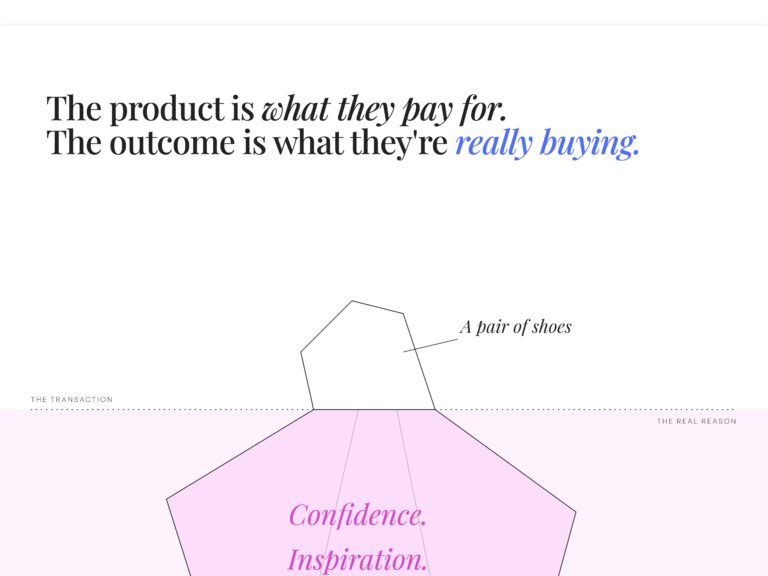
Nike has always known something that most brands quietly struggle to grasp: customers aren’t buying the product itself.
They’re buying an outcome the product makes possible.
In Nike’s case, it’s the feeling of crossing a finish line you didn’t think you could reach.
Of stepping onto a pitch and believing that you’re destined to win.
Of looking at yourself in the gym mirror and thinking “I’ve got one more rep left in me.”
Yes, Nike sells shoes and t-shirts.
But what it actually sells is inspiration and confidence to people who want to push their limits, and win.
At Nike, everyone intuitively understood this, because it was woven into the very fabric of the culture over time.
In the way we talked to the consumer, the way we talked to ourselves, the way decisions were made. It could be felt everywhere.
This made designing a loyalty initiative considerably easier, because we knew exactly what we were in service of.
Most brands, however, aren’t that lucky. In fact, most brands haven’t done “the work” yet.
What do we mean by “the work”? This is today’s theme.
This is Part 1 of Before You Build — a content series for brand-side practitioners working through the questions that matter before any loyalty programme is designed. Each part is built around one diagnostic question, and together, they are designed to help you make loyalty programme decisions that are right for your brand and your customers.
When a brand decides it’s time to build a loyalty programme, the conversation usually starts in the wrong place.
It starts with things like the programme mechanics.
Points or no points? An app or a card? Tiers or a flat structure?
These are all relevant questions, and you would have to answer them eventually.
But they’re the wrong ones to start with.
The first question should be a simpler, and harder one:
What are your customers actually buying?
Not what product they’re purchasing, but what they’re really after.
The underlying need, the feeling, or the job they’re asking your brand to help them with.
You don’t have to be well read on marketing literature to apply this kind of thinking (but if you’re interested, this is a good place to start).
You just need to look past the transaction.
- When someone pays for Amazon Prime, they’re not just buying a year of free next-day delivery. They’re buying “convenience” and “peace of mind” that whatever they need will arrive tomorrow, even if they remember them last minute.
- When someone buys a Patagonia jacket, they’re not just buying outdoor gear. They’re buying a “status” signal, to themselves and others, that they care about the planet.
- When someone walks into a Starbucks and pays five euros (!) for a coffee they could make at home for free (almost), they’re buying something else than a hot drink. Thirty minutes of me time to reflect, or a precious chance to re-connect with a friend or a loved one. That’s what they’re really buying.
The point is, the product you sell is the vehicle, and the outcome is the destination.
The question nobody asks first
A loyalty programme that doesn’t understand what its customers are actually buying will always feel like a bolt-on.
A discount mechanic wearing a membership badge.
It might move transactions in the short term.
But it won’t shift the customer relationship in a meaningful way, because you’re not addressing the real reasons they’re coming to you for.
When you know what your customers are really buying, programme design becomes considerably more purposeful.
You’re no longer shooting in the dark on reward options or programme mechanics. You’re asking:
What loyalty programme benefits, experiences, and forms of recognition will serve the same underlying needs the brand already serves, so that they’re met in the best way possible?
That question points you toward the right answer much faster than any competitive benchmarking exercise.
- A brand selling confidence should reward its most loyal members with things that reinforce that feeling: exclusive access, recognition, or status.
- A brand built on conscience should give members more ways to feel like they’re doing good.
- A brand selling convenience should protect that experience above all else, and not undermine it with complicated programme mechanics that might confuse them.
Start with these questions first
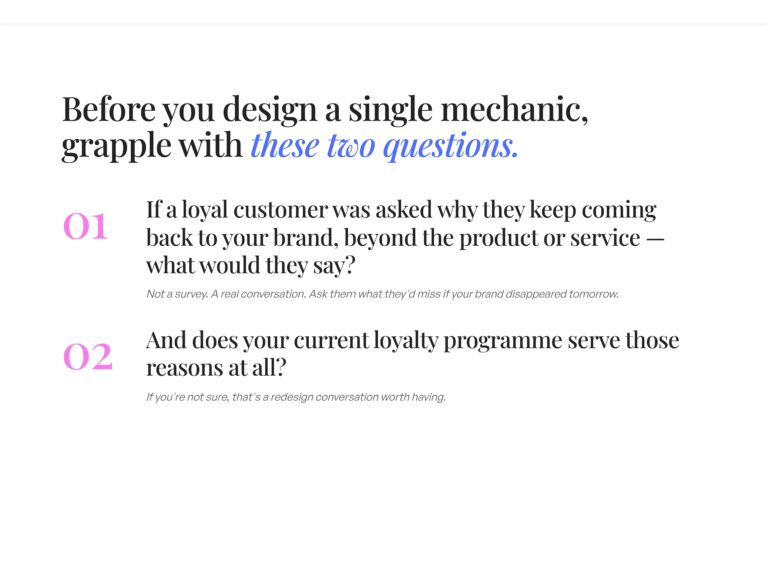
Before you design a single mechanic for your loyalty programme, I invite you to grapple with these two questions:
- If a loyal customer was asked why they keep coming back to your brand, beyond the actual product or service, what would they say?
- And does your current loyalty programme serve those reasons at all?
If you’re not sure of the answer to the first question, that’s your starting point.
Talk to your most loyal customers. Not a survey, but a real conversation.
Ask them what they’d miss if your brand disappeared tomorrow.
Their answers will reveal more about what your programme should look like than any industry benchmark report.
If you know that answer but aren’t sure about the second question, whether your programme actually serves it, that’s a redesign conversation worth having.
Coming up next
Understanding what your customers are really buying is the starting point.
The next question is how to make sure your loyalty programme serves the whole business, and not just your own function.
The next part of the series looks at why programmes designed in isolation always end up fighting for their lives (internally), and what happens when loyalty is genuinely integrated into a brand’s growth model.

Koji Hayashi is an independent loyalty and CRM consultant based in Amsterdam. In the past decade, he has designed, launched and scaled loyalty programmes at leading brands such as Nike and Tommy Hilfiger, and he now helps consumer brands turn their customer base into a compounding revenue engine, without relying on discounts or paid acquisition.
If you’re working through a loyalty or CRM challenge and want a fresh perspective, book a free 30-minute discovery call: calendar.app.google/eGd6pUxsTXZoxepd8
Connect: linkedin.com/in/koji-hayashi | koji@asayakestudio.com
